Educational Value
Planet of the Apes (1968) features many differnt examples of technological innovations. A key innovation in the start of the movie is their advanced
cryosleep technologies. At the start of the movie, the astronauts are seen to be asleep in their cryosleep chambers, which allowed them to stay alive for two
millenia.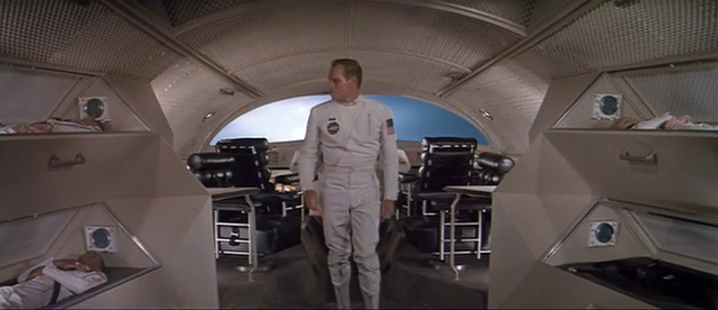
The crew is in cryosleep, as Taylor looks around
As of 2026, Cryosleep, or cryonics as the more general term, are considered to be pseudoscience, as there is very little evidence to support the idea that a brain can retain function after being frozen for days, let alone millenia. When the body, or any large organ, is frozen, it is currently impossible to prevent that organ from fracturing, and when it unfreezes, those fractures lead to the object becoming biologically unviable. The body needs to be soaked in a protective solution, but that takes a long time, and it could lead to eitther the frozen body being ruptured before the body is fully soaked, or suffer from necrosis (uncontrolled cell death) before the solution is done soaking. Assuming, somehow, we manage to perfect cryonics, we still have absolutely zero idea how to go about thawing them, as you would need to fix oxygen deprevation, the toxity of the preservants, and, most importantly, the fracturing.In conjunction with the cryosleep, the astronauts use a futuristic spaceship that spends two millenia in space, traveling at near lightspeed, quoted from astronaut Taylor. Einsteins Theory of Special Relativity states that that no object can go faster than the speed of light. As of 2026, there is no way to get even close to the speed of light, as it is, with current technology, phyiscally impossible to get something going that goes that fast. Therefore, we must look to the theoretical. A theoretical proposition, proposed by theoretical physicist Miguel Alcubierre, the Alcubierre drive is a method of propulsion that "shortens" the distance between you and your destination, and "lengthens" the distance between you and your origin. It uses the idea that creating an area of negative energy density, i.e less dense than a vacuum, you could use it to propel a ship through space. While this is possible, in theory, scientists have been unable to construct a prototype, leaving the Alcubierre drive in purgatory.
Planet of the Apes is a movie where much of the technological aspects are rooted in factually proven science as much as theoretical science. The time dilation that the astronauts go to are proven, as the close one gets to the speed of light, the slower they experience time. But the faster than light travel and their use of cryosleep means that much of the movie remains as much in science fiction as it did in the '60s as it does today.
Entertainment Value
86% Tomatometer, 88% Popcornmeter
-Rotten Tomatoes
"...Planet of the Apes” is much better than I expected it to be. It is quickly paced, completely entertaining, and its philosophical pretensions don’t get in the way."
-Roger Ebert
"You can feel its iconic nature at every turn; the location work and sets bring scope to the world, and it is great watching Charlton Heston rip through every scene with gusto."
-TLDR Movie Reviews
My Take
I personally see the 1968 Planet of the Apes as one of my favorite movies of all time. The story is well-written, especially when you take into account the cold war environment at the time. The themes of control, sentience, and science are introduced and critical to the coherence of the story. Contrasting characters in the simian society help the watcher imagine that the apes are not all the same, just like in the same vein of not all humans are the same. Some of the apes want Taylor to be castrated and cast away; others want him to remain, to tell them his story. Charlton Heston helps to bring it together, as he is a commanding force, and he plays the role of astronaut-turned-prisoner very well. He doesn't let the Apes bully him around, and he makes ure his opinions are known, even if they are not heard. And this movie benefits greatly from having one of the most iconic movie endings of all time: Taylor weeping and crying at seeing the destroyed Statue of Liberty. Overall, I would give this movie an 8/10, due to its themes, story, and characters.